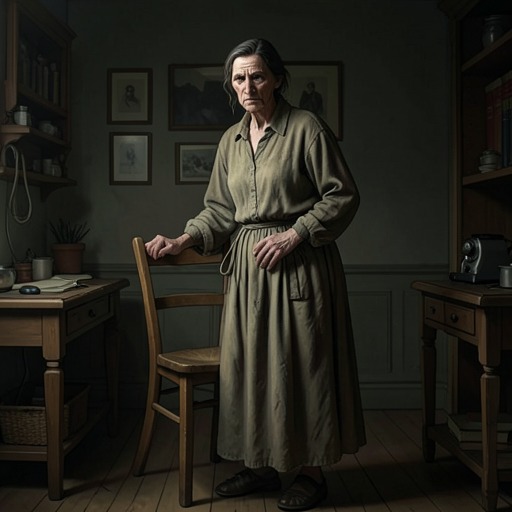
Grandma Henrouille's alleged insanity and confinement
Journey to the End of the NightGrandma Henrouille’s alleged insanity and confinement are not settled facts but a family project: her son and daughter-in-law call her mad and seek medical help to have her committed, while she insists that she is in her right mind and resists their intervention. Living alone in a garden shed and dependent on relatives who control her small pension, she is both materially vulnerable and fiercely unwilling to surrender her independence. Her later decision to leave the shed and visit Ferdinand Bardamu makes the family’s description of her as incapable harder to accept at face value.
Background and Conditions
For more than twenty years, Grandma Henrouille has lived in a low shed at the far end of the garden, among discarded household objects and the shadows of neighboring buildings. She seldom leaves it, will not admit even her son, and fears that her relatives intend to kill her. Her isolation is real, but it does not by itself establish the illness her family claims to see in her.
Her son keeps her small pension, while meals are left outside her door. The arrangement supports her but also leaves her financially dependent on the same family she distrusts. When she complains, her daughter-in-law answers that the pains of old age are unavoidable; Grandma rejects this as a lie and refuses to accept age as an explanation that should silence her.
The house and family circumstances sharpen the conflict. The daughter-in-law wants the household to save money and proposes sending the old woman to St. Vincent’s Convent, where the Sisters care for elderly women described as feeble-minded. Her husband neither endorses nor openly rejects the proposal. He is absorbed by persistent noises in his ears and fears that they will keep him from sleeping. His withdrawal leaves his wife to press the plan and the old woman to confront it.
The Confinement Proposal
The family asks Bardamu to see Grandma Henrouille, first seeking medicine to quiet her and, more importantly, hoping that he will help secure her commitment. The daughter-in-law presents the institution as a place of care: the shed is cold, Grandma has no fire, and, she says, the old woman refuses proper assistance. These concerns coexist with another practical grievance: the pension is too small for the family’s needs, and the daughter-in-law says the cost of living has risen.
Grandma’s response is to demand the return of her money. She says she can live on her annual pension and leave them alone; her family counters that the sum is no longer sufficient. The argument therefore concerns more than a medical judgment. It is also about possession of her income, her housing, and the right to decide whether she must accept the Sisters’ care.
When the family presses Bardamu to agree that she is mad, he does not provide the endorsement they seek. Grandma challenges his authority to diagnose her from outside her mind, orders him and her relatives out, and tells him to examine her son instead. She points to her son’s poor teeth and recalls that they were sound when she cared for him. After slamming the door, she watches the visitors leave and laughs at having defended herself. The confrontation ends not with a diagnosis or commitment, but with her dismissal of the people attempting to arrange one.
A Contested Diagnosis
The narrative distinguishes the family’s label from what Bardamu observes. Grandma is described as discontented and living in severe deprivation, yet also as merry, verbally energetic, and possessed of a lively, youthful expression. Her fear is directed chiefly toward the outside world, which she believes may enter her home and take her away; she appears confident in her own mind even as she rejects contact with the people who would assess it.
Bardamu reflects that the label of madness is easy to apply, particularly when a person has scarcely left home for years. He allows that Grandma may have reasons for her seclusion and may be protecting something she will not explain to people she regards as estranged from life. This does not prove that she is free of illness. It does, however, make her isolation insufficient as a verdict and exposes how easily nonconformity, poverty, and refusal can be recast as incapacity.
The family’s appeal to care is similarly unsettled. Its proposed solution would remove Grandma from her shed and place her under institutional supervision, but the relatives also hold her pension and want Bardamu to make the arrangement possible. His reluctance to cooperate prevents the medical visit from simply converting their domestic conflict into an official finding.
Leaving the Shed
Grandma later walks out of her home without asking permission and goes to see Bardamu herself. She returns repeatedly to ask whether he truly thinks she is insane, turning the consultation into a question she can pursue on her own terms. Rather than appearing only as the family’s secluded dependent, she becomes a visitor who chooses where to go and whom to question.
Bardamu’s waiting room is furnished with only three chairs and a small three-legged table. Grandma sits there and comforts Bébert’s aunt, recounting the many relatives she has outlived, though some of the details of her daughters’ lives have grown indistinct. When the aunt invites those present to Bébert’s funeral, Grandma agrees, saying that people should be around one at such times. Bardamu promises not to proceed with the commitment, and the old woman has, in his words, become a gadabout. Her visits do not erase her deprivation or settle every question about her mental state; they do show a change from enforced-seeming seclusion to chosen movement and company.
Institutional Context and Significance
The episode sits within a broader pattern in which institutions observe, classify, and redirect vulnerable people. During the war, Bardamu is among wounded soldiers held for observation because their patriotism is considered impaired; staff monitor them, and their possible destinations include an asylum, the front, or a firing squad. At Ford’s, new workers are stripped for medical examination and told that health and intelligence are irrelevant so long as they perform their assigned movements. At the rest home, patients’ routines and behavior are supervised under rules intended to protect the institution’s reputation.
These settings are not identical to the Henrouille home, but their recurrence gives the proposed commitment a wider resonance. In each, a claim of care or order is joined to observation and control over what happens to a person’s body and future. Grandma’s relatives seek medical authority to make her confinement acceptable; Bardamu’s hesitation interrupts that process, while her later visits make her agency visible beyond the household’s account of her.
The episode’s central uncertainty is therefore preserved rather than resolved. Grandma may be difficult, fearful, and profoundly isolated, but the evidence also shows her capacity to argue, refuse, remember, comfort another person, and leave her home. The attempted diagnosis reveals as much about the family’s anxieties and interests as it does about the woman they want confined.